There are several newspaper reports on the incident that saw Thomas Finlan forced to depart from the fair city of Dublin. They identify his ‘oops’moment, that is, caught on the run with both a weapon and stolen property leaving a public house after likely treating himself to a pint. Maybe the close call after being shot at left him feeling a bit shaken up and the hat told a good story.
Fortunately for me, the newspapers of the day were thorough in detail when reporting incidents. Three published articles in particular give great detail on some of Thomas’ associates as well as himself. This adds context and it would be certainly interesting to see what became of his associates as well. Maybe I will follow up one day.
(The parts of the post in italics are verbatim from the articles referenced).
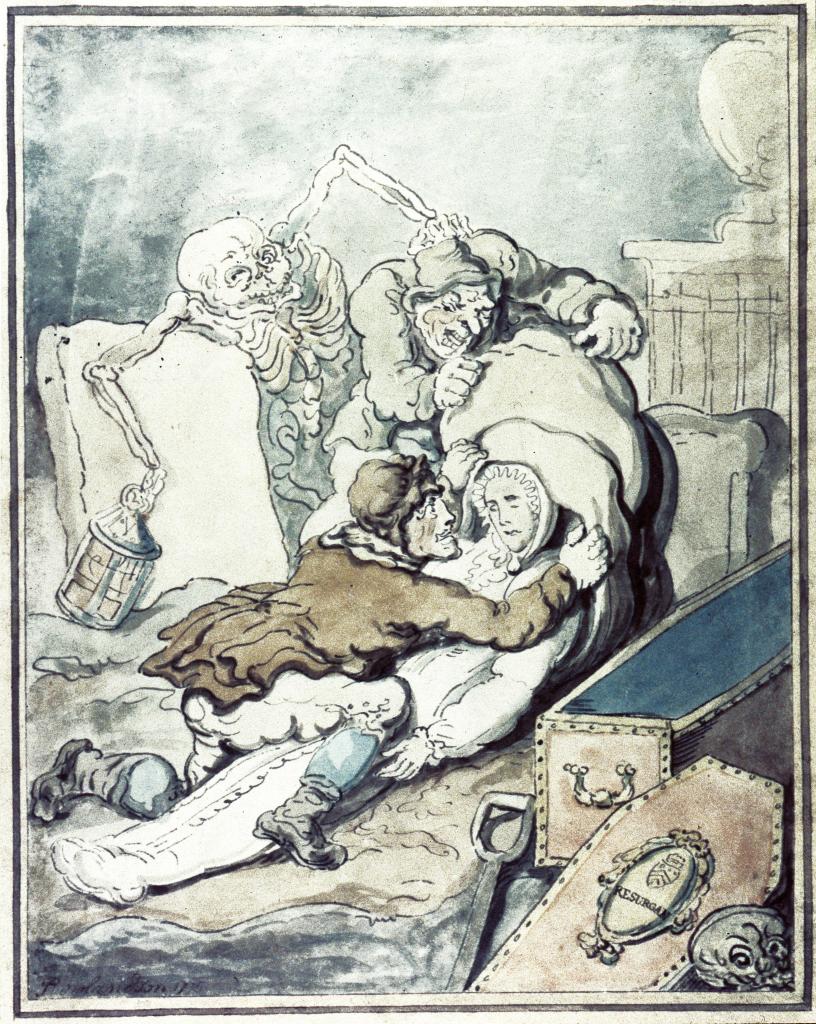
Two men placing the shrouded corpse which they have just disinterred into a sack while Death, as a nightwatchman holding a lantern, grabs one of the grave-robbers from behind. Coloured drawing by T. Rowlandson, 1775.
Gray’s Anatomy, the biblefor generations of medical professionals, is referenced in novels and movies as diverse as The Addams Family, Gabaldon’s Voyager, Star Trek: Voyager, Dan Brown’s Inferno and Buffy the Vampire Slayer. The 42nd edition is still in use today.
The original text was written in 1859 by doctors Henry Gray and Henry Vandyke Carter as an anatomical guide for their colleagues. The original text was well before the invention of imaging and is striking for its detail on the inner mysteries of the human body. Acknowledging how the first edition could be so detailed is not something we generally consider. I certainly didn’t think about the practicalities in gaining the necessary understanding of the inner workings of the body until I discovered that my four times great grandfather Thomas Finlan was in a Dublin based gang and a resurrectionist to boot.
Gangs of resurrectionists followed in the footsteps of the original ‘body snatchers’, that is, the teachers and students of anatomy who, according to Ball in his treatise on the practice, were respectable resurrectionists.[1] Although other parties were actively providing anatomists with exhumed bodies to meet demand, the first grave robbers, from as early as the 1700’s were principally the anatomists, surgeons and students.[2] It was common for leading surgeons revered even today for their discoveries to have been personally engaged with the practice in their student days. As demand for corpses grew, an increasingly incensed public meant students and anatomists were putting their personally safety at risk. The solution was to turn to hiring gangs of resurrectionists for supply to their teaching schools.
The end of Thomas life seems to me to portray an everyday hard working family man. On tracing back, however, it seems he was ‘notorious’‘, ‘in the most daring gang to ever infest the neighbourhood’, and engaged in not so mysterious ‘doings’ in Dublin.
The earliest reference I found to Thomas was an article pertaining to his arrest. It stated that
McDonogh and Scott apprehended [the suspect]…coming out of Duignan’s public house in Mercer Street… found a large horse pistol… his own hat was subsequently found on the road at the scene of action. These fellows were soon recognised as two of a gang who made themselves notorious for their robberies within the last month… the pistolman the notorious Thomas Finla[y]n, who have very lately been spending seven months in Newgate for similar doings. He and his companion were committed till next Commission, which will sit at Kilmainham on the 9th of next month.[1]
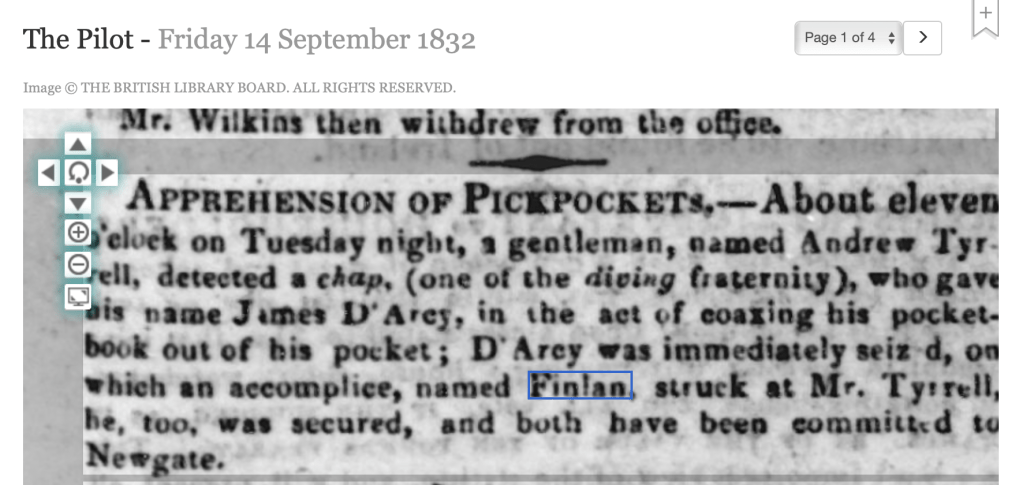
Then I found this one…Thomas had been caught picking pockets in September 1832[2].
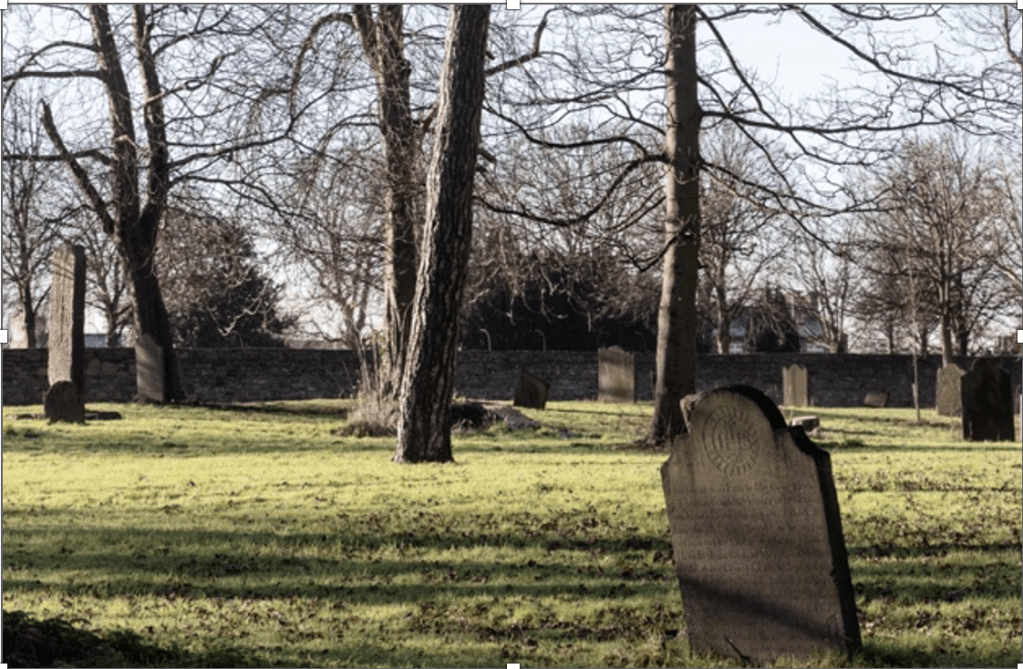
It takes ten minutes to walk from my home to the Broadstone Luas stop near Grangegorman in North Dublin. Broadstone is opposite Kings Inn Park, Irelands oldest school of law and the home of the ‘Hungry Tree’ on Constitution Hill, a short walk to a previous tenement turned tourist attraction at 14 Henrietta Street, and 750 metres to St Michans Park, the site of the former Newgate Prison in Dublin on the corner of Halston and Little Britain Streets. It is an area full of historical importance that is not so immediately obvious today. But what do these areas have in common, why this photo, and how are they connected to Thomas?
Image of Bully’s Acre Kilmainham, Dublin, Ireland Personal Photo Denise Brown
The photo is of a place. Thomas Finlan left no photo of himself, it was too early for that. The place, Bully’s Acre, was a burial ground he perhaps knew rather well. It is connected to events and conditions, unimaginable for many of us, that he lived through and which I imagine influenced his decisions. Additionally, his stomping ground then is partly mine today which is somewhat strange to me. I am not from Ireland and never imagined that one day I would live here.
One of the newspaper reports of Thomas’ arrest for highway robbery in 1833 stated that
“In about 2 hours, after Dunn was taken into custody, Peace officers McDonagh and Scott arrested a well-known resurrectionist, Thomas Finlan, as he was coming out of a public house on Mercer Street…Finlan was immediately identified as the person who had attacked Mr Dunroche…it is only due to the police these arrests have been made…one of the most daring gangs that ever infested the neighbourhood of this city has been at length arrested…
This is a hard question to answer because in truth I would like to meet them all. I have too many questions and there is a lot of smoke and misdirection surrounding the lives of most, particularly those who ended up in New South Wales in Australia in the early nineteenth century, either compelled to ’emigrate’ or by personal choice.
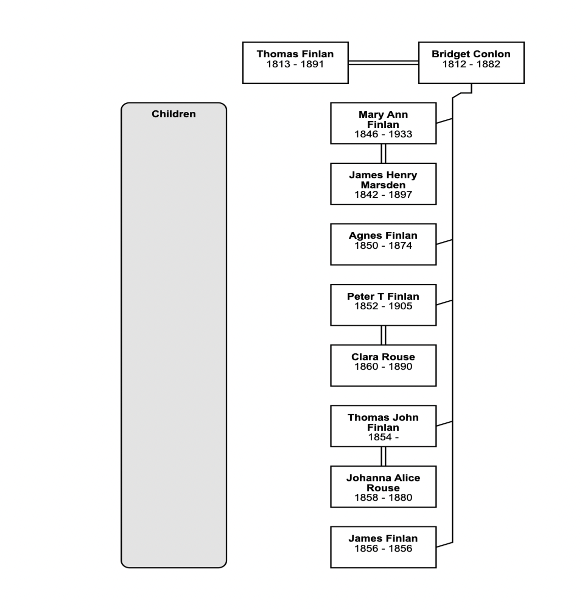
I would like to focus on one couple, Thomas Finlan and Bridget Conlon alias Tunney, in particular for the next eight weeks worth of prompts so this will not really be 52 ancestors but hopefully close to 52 weeks of posts. Thomas and Bridget were both from Ireland, one from the east coast and one from the west coast, both convicts, and both transported in the early to mid 1830s. Their crimes were polar opposites, but both seem to have had a rebellious and independent streak, were resilient and I like to think, were at least somewhat happy with the way their lives turned out.
Thomas Finlan was born in County Carlow in Ireland c1809. There is no definitive evidence of date, townland, names of parents or other identifying facts to help get beyond that rather sparse information found to date. The name Finlan was more common in the South East of Ireland in the nineteenth century, particularly in County’s Carlow and Kilkenny so it is likely that Carlow is correct. Further, it was given on son James’ birth certificate in 1856 and Thomas was the informant in this instance. Convict records record Thomas as from County Dublin, where he was caught and convicted.

 Tales2Tell