
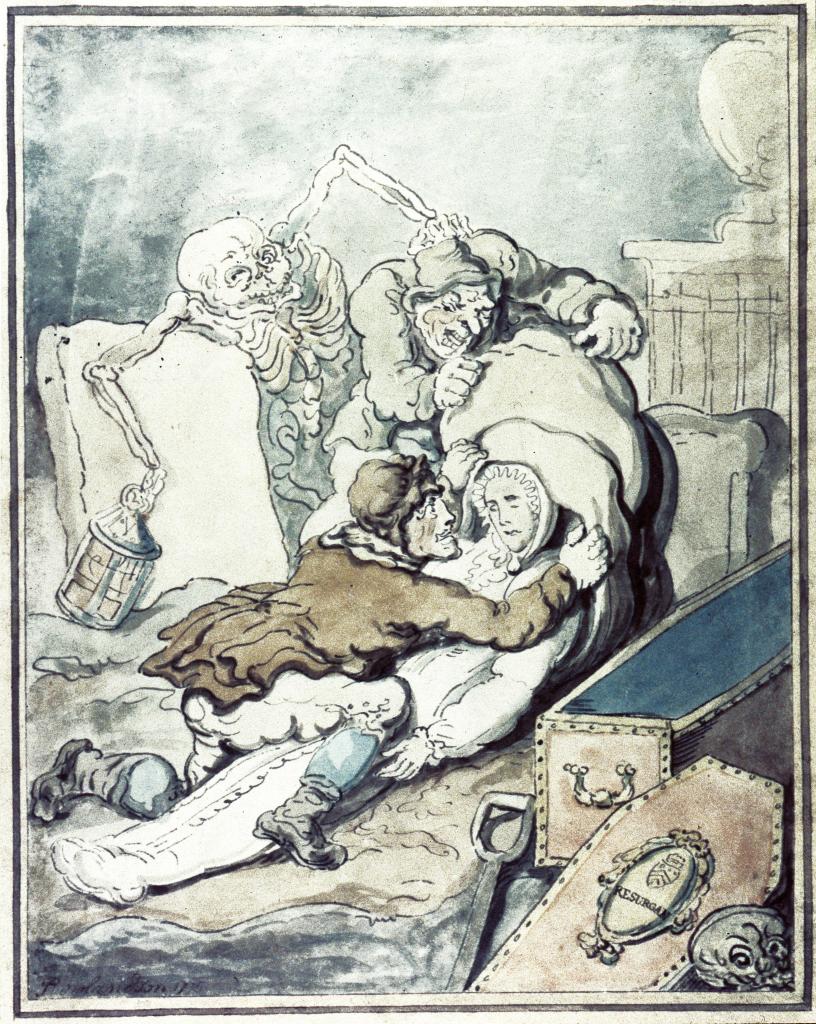
Gray’s Anatomy, the bible for generations of medical professionals, is referenced in novels and movies as diverse as The Addams Family, Gabaldon’s Voyager, Star Trek: Voyager, Dan Brown’s Inferno and Buffy the Vampire Slayer. The 42nd edition is still in use today.
The original text was written in 1859 by doctors Henry Gray and Henry Vandyke Carter as an anatomical guide for their colleagues. The original text was well before the invention of imaging and is striking for its detail on the inner mysteries of the human body. Acknowledging how the first edition could be so detailed is not something we generally consider. I certainly didn’t think about the practicalities in gaining the necessary understanding of the inner workings of the body until I discovered that my four times great grandfather Thomas Finlan was in a Dublin based gang and a resurrectionist to boot.
Gangs of resurrectionists followed in the footsteps of the original ‘body snatchers’, that is, the teachers and students of anatomy who, according to Ball in his treatise on the practice, were respectable resurrectionists.[1] Although other parties were actively providing anatomists with exhumed bodies to meet demand, the first grave robbers, from as early as the 1700’s were principally the anatomists, surgeons and students.[2] It was common for leading surgeons revered even today for their discoveries to have been personally engaged with the practice in their student days. As demand for corpses grew, an increasingly incensed public meant students and anatomists were putting their personally safety at risk. The solution was to turn to hiring gangs of resurrectionists for supply to their teaching schools.
Why did schools and students turn to graveyards and resurrectionists for a supply of corpses for educational purposes in the first place? One answer was the practicality on how to develop speed and skill without extensive knowledge and practice? Practicing on live patients without the requisite expertise in an emergency is not ideal today and it wasn’t two hundred years ago.
A small number of charters and Acts did support the provision of bodies for dissection either directly or indirectly. The last of these had some influence on the practice or resurrectionism.
- 1542 Act of Parliament allowing ‘The Company of Barbers and Surgeons’ to claim four bodies of executed criminals per year for the purpose of study and dissection.
- King Charles 1636 charter increasing the number of hanged criminal’s bodies available to Oxford University for dissection (bodies up to twenty one miles from the town).
- Murder Act 1752 by which the Company of Surgeons in London were to conduct public dissections and the exposure to the general public of the bodies of convicted murders. This was a final form or punishment and saw public perception connect murder with dissection. Often problems arose as friends and family fought to prevent the delivery of the corpse to the anatomist.
- An increase in the number of crimes punishable by hanging to over 200 in response to panic over a seeming increase in crime (mainly due to newspaper coverage). Numbers of executions did decline however, as up to ninety percent of those sentenced to death had sentences reduced by the early nineteenth century. Thomas is an example of this. His original sentence was death but he was sent to Australia as a convict instead.
- Warburton’s Anatomy Act 1832 permitting bodies of unclaimed poor to be used in dissection (one reason for the passing of the Act was to stop the trade in it tracks). As an aside and in a connection to the previous post on cholera, the bill that preceded the passing of the Act was introduced after a report in 1828 and defeated in the House of Lords June 1829 as it ‘associate[d] the poor with the worst criminals.’ At least in the minds of many. The outbreak of the cholera epidemic in May 1832 in Liverpool resulted in rioting and violence as the public feared deliberate infection by physicians so they would have access to bodies. It was reported that the poor believed cholera was ‘an invention’, and sufferers ‘victims of experiments’.[3]
Before 1832 the numbers of corpses available were not enough to meet demand (not really after that either). In the fifteen years between 1805-20, for example, London and Edinburgh alone had over one thousand medical students apiece and the whole of Britain only executed 1,150 criminals which is only around seventy seven per month.[4] The rise in students was due to a number of factors including:
- Military requirements for surgeons during the Napoleonic wars between 1803-1815. A number of private schools opened in England, Scotland and Ireland to meet this demand. Fifteen were opened in Dublin from 1804 to 1832.
- Larger numbers of middle class sons choosing medicine as a viable and respectable career.
- An Act in 1815 requiring apothecaries to complete courses in anatomy.
- The desire to better understand the effects of disease on the body requiring bodies that were not free from pathology.
- The reputations of professors including James McCartney at Trinity College and Abraham Colles at the College of Surgeons also encouraged students to attend private schools in Dublin.[5]
The published diary of a member of a London based gang, Joseph Naples dated 1811-1812, opens in Chapter One with the following statement
“The complaint as to the scarcity of bodies for dissection is as old as the history of anatomy itself”.[6]
Naples diary illustrates a number of well-known teachers and surgeons who bought the gangs corpses.
- Henry Cline, principle surgeon of St Thomas’ Hospital in London (Naples says that the hospital took six in the last week in one entry)
- Algernon Frampton, physician at London Hospital
- Joseph Constantine Carpue, anatomist
- Joshua Brooks, private teacher of anatomy
- James Wilson, teacher of anatomy at the Great Windmill Street School
- John Taunton, surgeon and lecturer in anatomy.
- ‘Bodies sent to Edinburgh’[7]
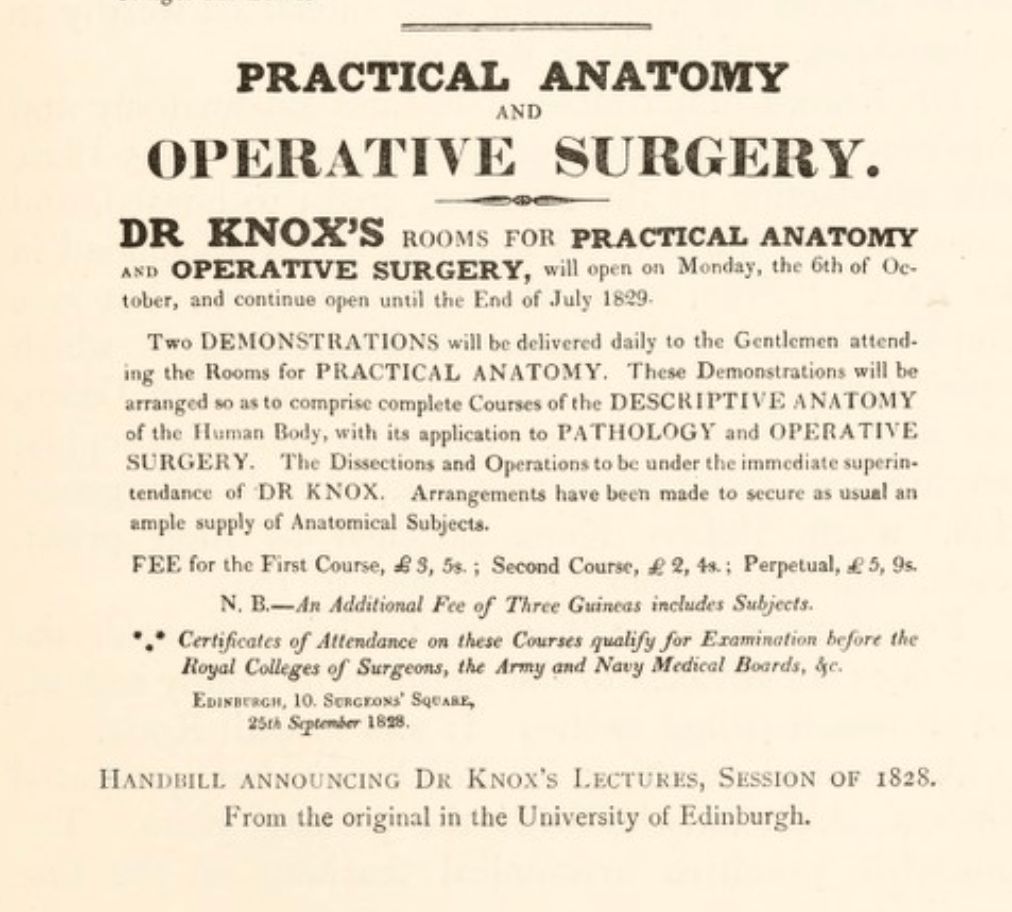
In 1828 a Select Committee Report on Anatomy suggests eight hundred students were attending medical schools in London alone with around sixty two percent of them practising dissection. The Corporation of Surgeons required students to produce a certificate stating they had attended a minimum of two courses of dissection – herein lay a problem for many students, few bodies for dissection where voluntary donated for the purpose of education[8]. As the following advertisement from Dr Knox in Edinburgh shows, anatomists where making significant profits from their lectures.
Sir Dominic Corrigan, a physician and MP in Dublin explains the process he and his fellow students engaged in when obtaining bodies in the early 1800s. He said a school porter would mingle with the bereaved to ascertain the suitability of the deceased and mark the graves. That evening a pensioner in the pay of the students would light a candle in the gatehouse window to give the all clear. The grave would be cleared at the head and shoulders of the coffin, a rope with an attached grapple (flattened iron hook) would be lowered and inserted under the edge of the lid of the coffin. This would be used to crack the lid whereby the other end of the rope would be placed around the neck of the corpse which would then be drawn up and carried away. Any clothing or shroud would be placed back in the coffin. He also mentioned the dangers of the trip home. Perpetrators sometimes had to flee while using sticks to beat off an angry mob if they were caught. Bodies would be laid east to west and were usually not six foot under but at a shallower depth.
Religious beliefs contributed to unease about dissections from early on. Both Anglicans and Catholics were concerned about the spiritual consequences, believing in death as sleep while awaiting the resurrection. Respect for the container of the soul, the body, was paramount. The deceased, at the hands of anatomist, was not treated with any dignity. The final act was invariably to discard the remnants of the body in a communal pit.[9]
As mentioned above, medical and private schools outsourced the trade to professional resurrectionist gangs, also known as sack ’em ups in Ireland.[10] Dublin had a flourishing and lucrative local and export trade. A rise in prices per corpse was driven by a thriving export business to supply London, Edinburgh and Glasgow. Short sea crossings and steam contributed to the trade. Dublin’s high mortality and large numbers of paupers contributed to a steady and regular supply of corpses.
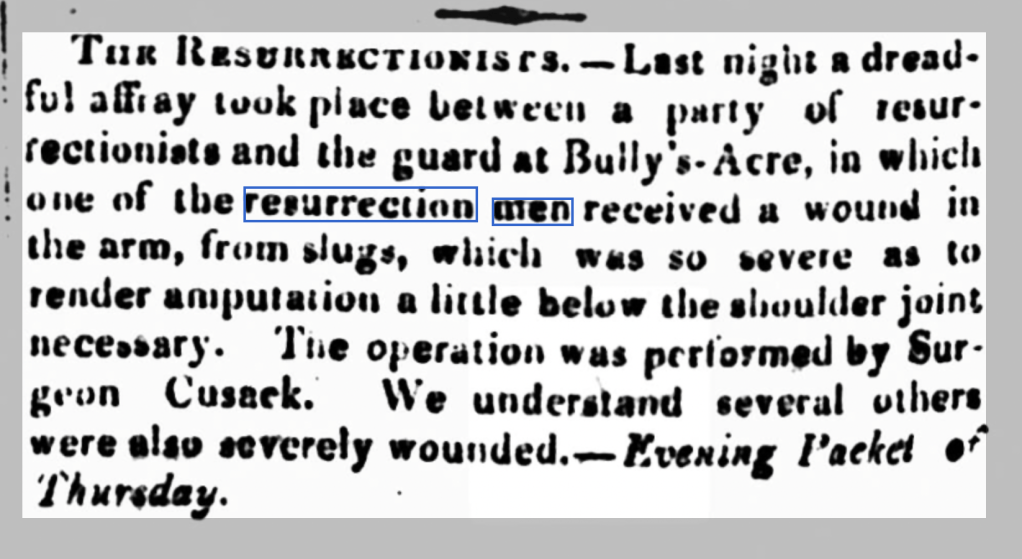
A number of rural graveyards were located in close proximity to the city and increasing demand resulted in the formation of gangs who stole to order and stored bodies at a central site for collection; it was compared to organised crime. Teeth and hair were also in demand. Some schools had to pay a retainer fee to gangs and would sometimes find themselves supporting families of jailed resurrectionists[11]. It could be a risky job as the following article published in 1831 records.
Another in 1833 records the risk resurrection men were taking.
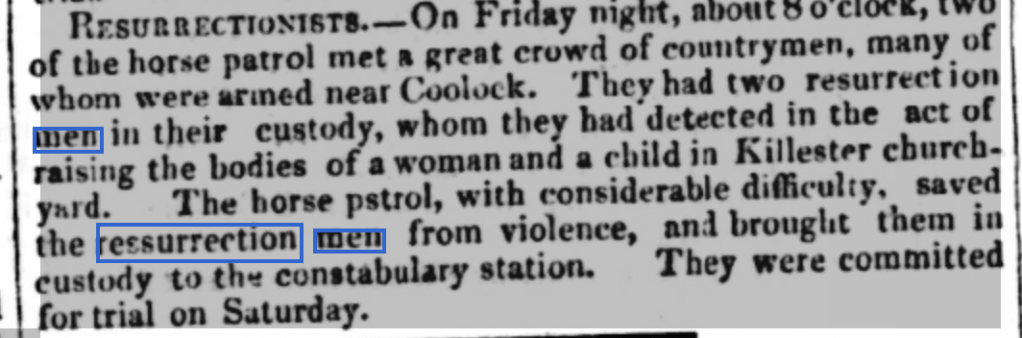
Surgeons would often have to pay retainment fees and support families of resurrectionists as a type of insurance policy. Sir Astley Cooper, anatomist and surgeon, recorded that in 1829 he paid the sum of six shillings to a resurrectionists wife and paid for the man’ confinement of twenty-six weeks to the sum of thirteen pounds.[12]
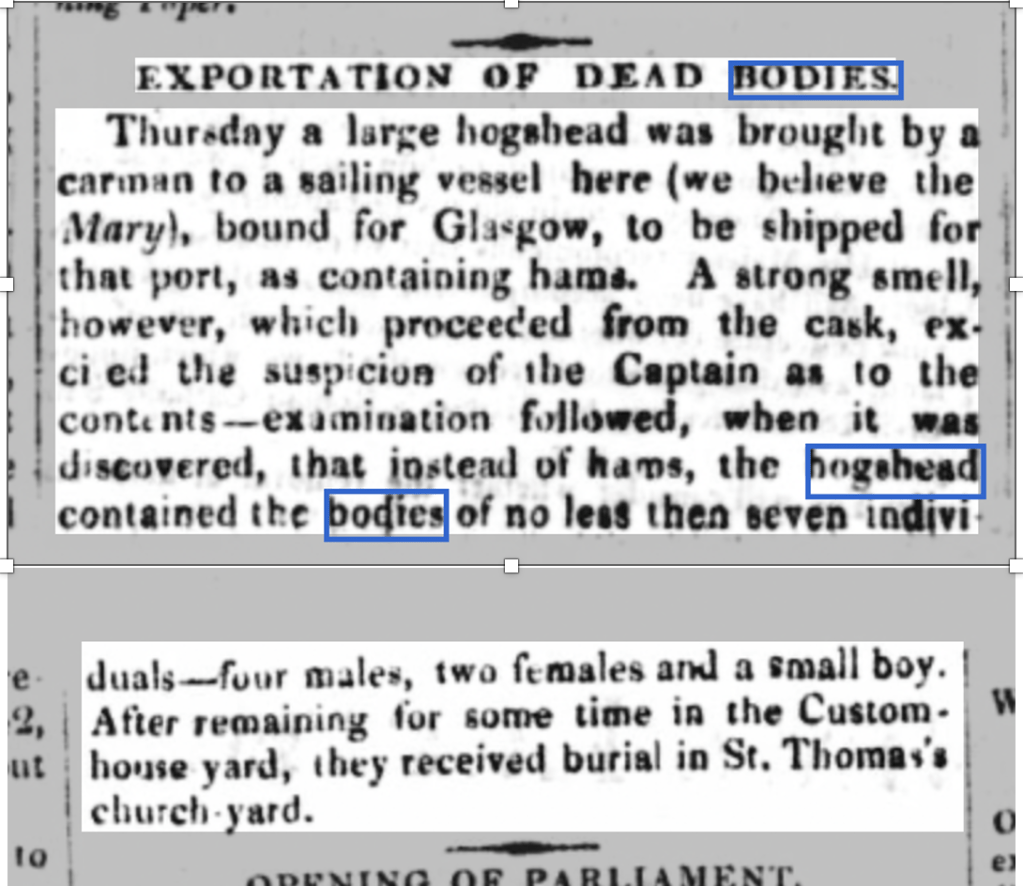
Sometimes bodies were absconded with before burial. Female members of gangs would pose as relatives of the deceased in workhouses or in the case of accidents and be entrusted with the responsibility for burial. In the early nineteenth century prices in London were sky rocketing to about £14 per body. Dublin was considerably cheaper, often more than 1500 percent cheaper in the late 1820s. A maximum recorded price in London for Irish exports £38 for three in late 1831. Some were stored at the College of Surgeons before export.[13] The papers included several reports of the trade. An example is in the article below, published in 1829.
The body itself was not considered property, unlike the theft of a sheep for example. Punishments for those caught were generally light, as long as the perpetrator was caught with a naked body (clothing was property). Resurrectionists might get away with no prosecution at all. It behoved families to protect their loved ones. Methods included families employing guards, building mort safes, using iron coffins, land mines and spring guns or delaying burial until the body had decomposed beyond use.[14]
Some graveyards built high wall and watchtowers to guard the dead, including Glasnevin Cemetery in Dublin.
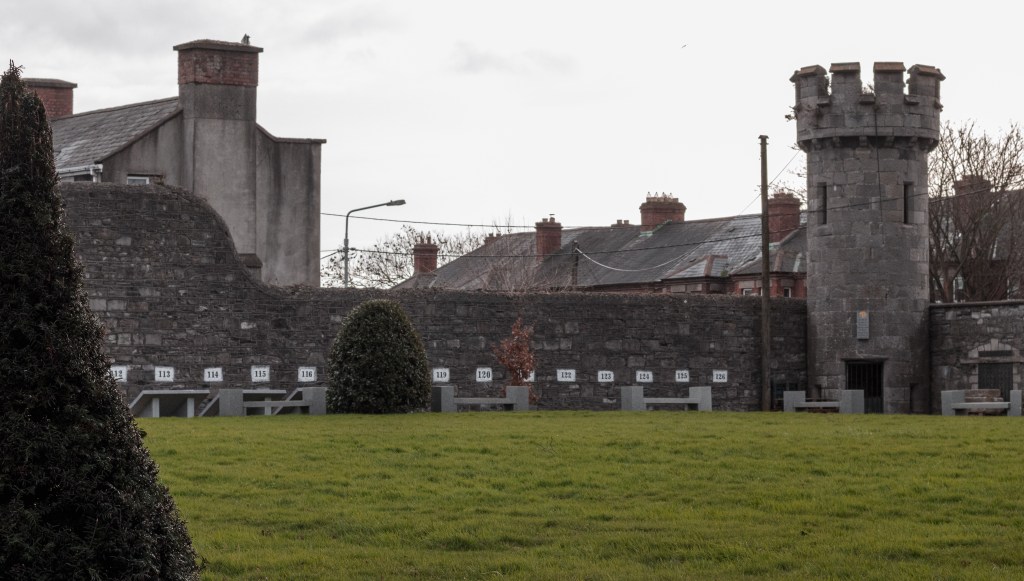
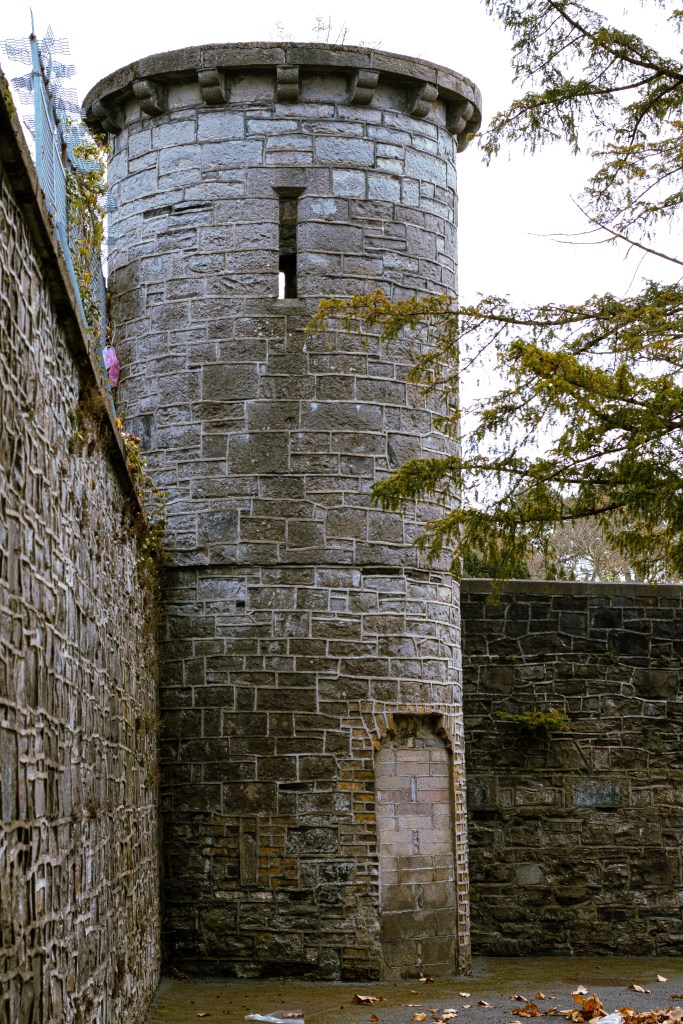
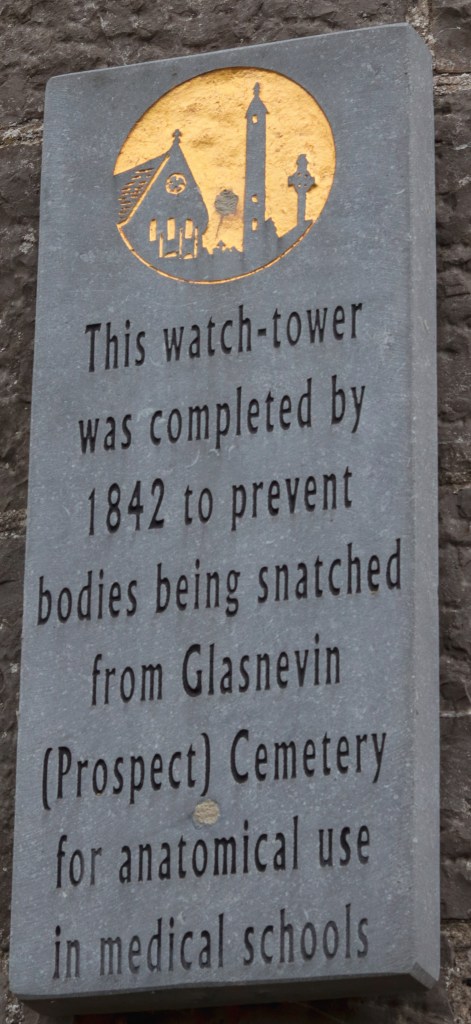
Increasing demand and value created a significant wave of thefts in the late 1820s and early 1830s. Several newspaper reports show armed resurrectionist gangs were not particularly circumspect and openly practicing the trade. It was not uncommon for confrontations with family and watchmen. Typically the gangs would carry ladders, lanterns, sacks, crooks and rope as well as carts nearby for transport.
‘A Sanguinary Affray with Resurrection Men’ in 1828 recorded a scene of ‘blood and outrage’ in Merrion Church-yard in which four brothers of a deceased sister and some of their friends kept watch on the grave. After leaving to rest in a nearby cabin whilst leaving two to keep watch, nine or ten people knocked and asked to have the grave pointed out so they might avoid it while they went about their business or raising subjects for dissection. The brothers and their friends refused to allow any bodies to be taken resulting in a brawl with ‘sticks, stones and fists’. The gang retired, threatening to be back at which time ‘the mildest consequence’ would be the loss of their loved one. They did return in the early hours of the morning with up to forty men armed guns, spades and pick axes. The brothers had also gathered reinforcements and a battle ensued. Injuries were numerous and severe with the streets back to city marked with traces of blood as the gang fled with their injured vowing vengeance. The graveyard walls, stones and tombs were liberally marked with shot.[15]
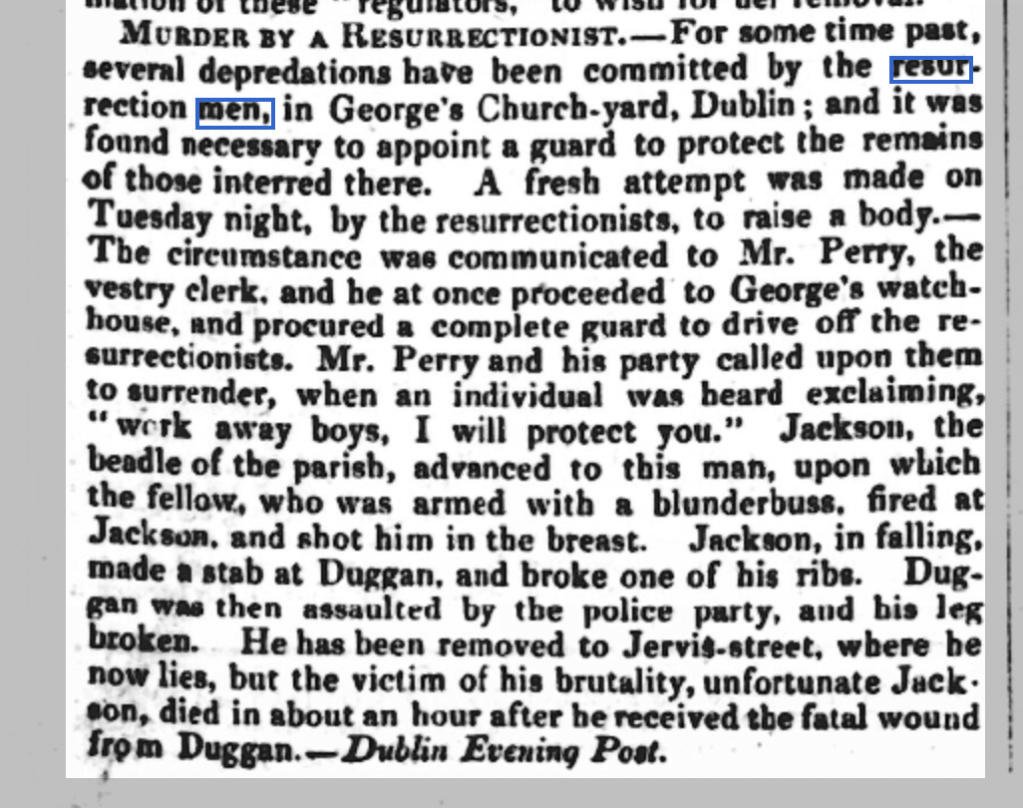
Another article reporting on the death of a beadle (official) of St George’s parish on the north side of Dublin showed the dangers to the public of confronting determined gangs of men.
A parliamentary select committee looking at ways to reform anatomical education in 1828 includes the report of James MacCartney, Professor of Anatomy and Surgery at Trinity College in Dublin given on 14 May of that year.
He had worked as a ‘demonstrator’ in both London and Ireland for at least thirty years and compares the environment over this period. He purports that smaller number of schools, students and abundance of bodies in London in the early nineteenth century as well as the rarity of prosecutions of resurrectionists had resulted in little outcry or conflict. The increase in all these had created competition and along with the ‘religious prejudices’ of the Scotch, respecting the ‘sanctity of the dead body’ had contributed to ‘excitement of the public feeling’. He concurs with the practice described by Corrigan that before about 1813 students would raise bodies with accompanying porters from their school. He introduced a system of resurrection men at this time himself with bodies costing between half a crown and ten shillings.
An increase in the number of schools and the introduction of an export trade since that time had contributed to ‘considerable difficulty’. He claimed that prices were now ten shillings to half a crown with a ‘gift at the end of the season’ and export prices at double that. His supposition that public fears of children being kidnapped and sent to England and Scotland from Ireland had incited public outrage resulting in beatings and whippings of resurrectionists and students alike. His perspective on the number of bodies needed per student was essentially ‘unlimited and practice at regular intervals throughout a career’ was preferable.
In the same report James Richard Bennett, lecturer in anatomy in London, stated that at Bully’s Acre, in his time, it was well known that bodies were taken mere hours after internment and that graves were rarely filled in after the fact. When queried as the character of resurrection men, invariably most claimed them to be the ‘lowest grade of the community’, thieves, pickpockets, and felons. A ‘retired’ resurrectionist reporting to the committee stated that according to his book he had provided 305 adults, 44 small subjects under three feet, 37 to Edinburgh and 18 never used in 1809 and 1810 in London.[16]
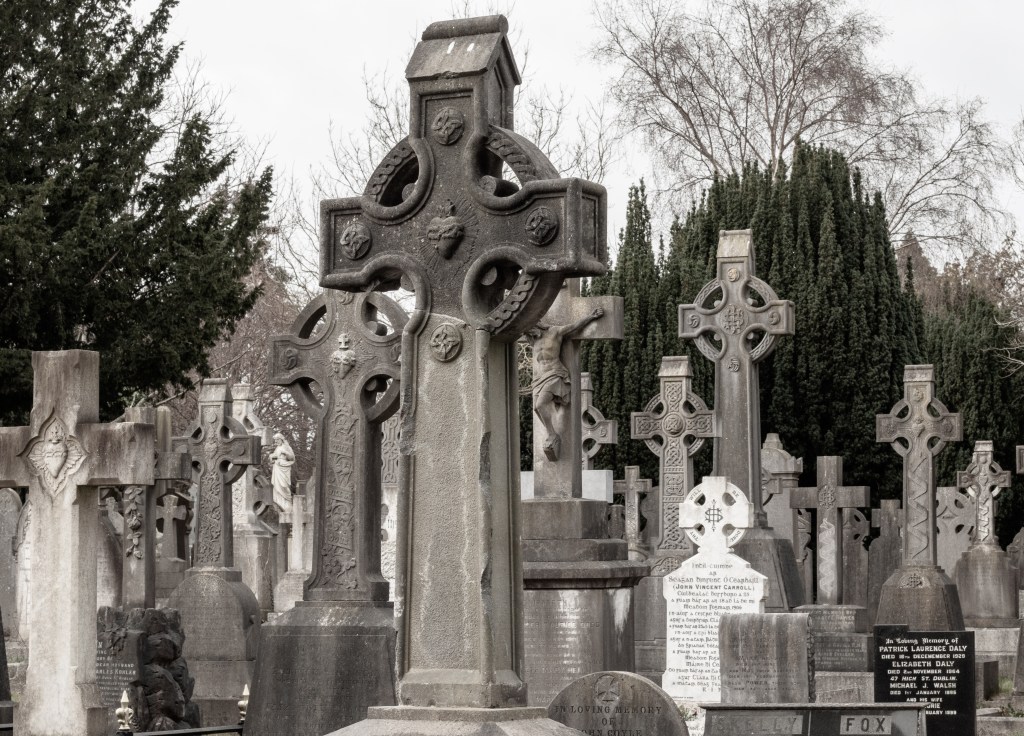
It is not known whether Thomas was involved in the export trade or how useful his trade as groom and coachman was to the gang he was actively engaged with. He perhaps was providing transport as part of his evening activities. He was caught with a gun so he definitely had access to arms. He was certainly risking life and limb after a fashion with his career in this period. Hopefully one day more information on Thomas will come to light.
[1] The sack-’em-up men : an account of the rise and fall of the modern resurrectionists / by James Moores Ball 1863-1929. Published: Published Edinburgh: Oliver and Boyd 1928. https://iiif.wellcomecollection.org/pdf/b29826317
[2] Burrows, Rebecca (Winter 2019) “The Anatomy Act of 1832: The Story of Bodysnatching, Dissections, and the Rise of Anatomy,” Tenor of Our Times: Vol. 9, Article 8. Available at: https://scholarworks.harding.edu/tenor/vol9/iss1/8
[3] Mitchell, P.D., Boston, C., Chamberlain, A.T., Chaplin, S., Chauhan, V., Evans, J., Fowler, L., Powers, N., Walker, D., Webb, H. and Witkin, A. (2011), The study of anatomy in England from 1700 to the early 20th century. Journal of Anatomy, 219: 91-99. https://doi.org/10.1111/j.1469-7580.2011.01381.x
[4] The evolving Rights of the Dead: The Anatomy of 1832 and the Expansion of Liberal Subjects in 19th Century Great Britain (2021). Dominic White, Thesis Bachelor of Science Degree with University Honors. Walsh Universtiy.
[5] Evans, A. (2010). Irish Resurrectionism: “This Execrable Trade.” Ulster Journal of Archaeology, 69, 155–170. http://www.jstor.org/stable/41940979
[6] Bailey JB (1896) The Diary of a Resurrectionist 1811–1812, to which are Added an Account of the Resurrection Men in London and a Short History of the Passing of the Anatomy Act. London: Swan Sonnenschein, 70. https://play.google.com/books/reader?id=wfRwmjbogtgC&pg=GBS.PR4
[7] https://www.pascalbonenfant.com and Bailey JB (1896) The Diary of a Resurrectionist 1811–1812, to which are Added an Account of the Resurrection Men in London and a Short History of the Passing of the Anatomy Act. London: Swan Sonnenschein, 70. https://play.google.com/books/reader?id=wfRwmjbogtgC&pg=GBS.PR4
[8] Report from the Select Committee on Anatomy 22 July 1828. House of Commons. https://iiif.wellcomecollection.org/pdf/b30459321
[9] Shane McCorristine (2019)The gruesome past of Irish medical education September 26, 2019
https://www.timeshighereducation.com/features/gruesome-past-irish-medical-education
[10] The sack-’em-up men : an account of the rise and fall of the modern resurrectionists / by James Moores Ball 1863-1929. Published Edinburgh: Oliver and Boyd 1928. https://iiif.wellcomecollection.org/pdf/b29826317
[11] Report from the Select Committee on Anatomy 22 July 1828. House of Commons. https://iiif.wellcomecollection.org/pdf/b30459321
[12] The sack-’em-up men : an account of the rise and fall of the modern resurrectionists / by James Moores Ball 1863-1929. Published: Published Edinburgh: Oliver and Boyd 1928. https://iiif.wellcomecollection.org/pdf/b29826317
[13] Fleetwood, J. F. (1989). The Dublin Body Snatchers: Part Two. Dublin Historical Record, 42(2), 42–52. http://www.jstor.org/stable/30087188
[14] O’Brien, Eoin (1983) Conscience and Conflict: A Biography of Sir Dominic Corrigan 1802-1880 Published: Dublin: The Glendale Press
[15] Saunder’s News-Letter 10 December 1828 Britishnewspaperarchives Accessed 31 January 2023
[16] Report from the Select Committee on Anatomy 22 July 1828. House of Commons. https://iiif.wellcomecollection.org/pdf/b30459321


