
Ancestors in 52 Weeks
This is a hard question to answer because in truth I would like to meet them all. I have too many questions and there is a lot of smoke and misdirection surrounding the lives of most, particularly those who ended up in New South Wales in Australia in the early nineteenth century, either compelled to ’emigrate’ or by personal choice.
I would like to focus on one couple, Thomas Finlan and Bridget Conlon alias Tunney, in particular for the next eight weeks worth of prompts so this will not really be 52 ancestors but hopefully close to 52 weeks of posts. Thomas and Bridget were both from Ireland, one from the east coast and one from the west coast, both convicts, and both transported in the early to mid 1830s. Their crimes were polar opposites, but both seem to have had a rebellious and independent streak, were resilient and I like to think, were at least somewhat happy with the way their lives turned out.
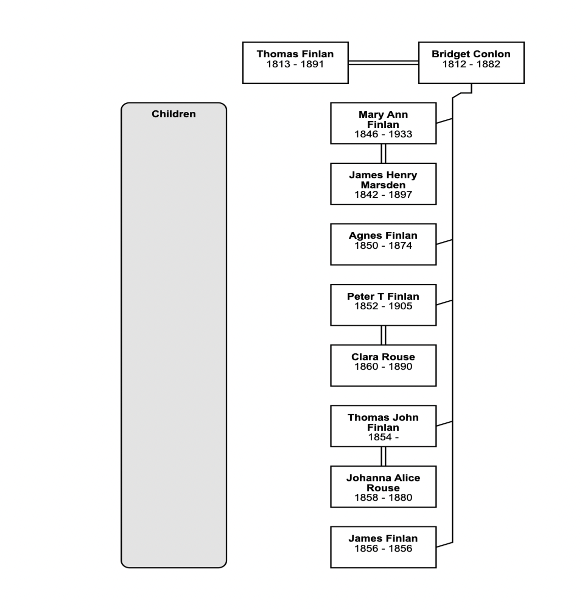
Thomas Finlan was born in County Carlow in Ireland c1809. There is no definitive evidence of date, townland, names of parents or other identifying facts to help get beyond that rather sparse information found to date. The name Finlan was more common in the South East of Ireland in the nineteenth century, particularly in County’s Carlow and Kilkenny so it is likely that Carlow is correct. Further, it was given on son James’ birth certificate in 1856 and Thomas was the informant in this instance. Convict records record Thomas as from County Dublin, where he was caught and convicted.
Thomas was convicted in early January 1834, appearing before Judges Johnston and Vandeleur, for ‘assault on highway with intent to commit robbery’ on 27 September 1833 in Dublin, Ireland. His original sentence of death was commuted to transportation for seven years. This was not unusual as labour was needed in the British colony. He was originally incarcerated in Kilmainhaim Gaol in Dublin from which he was discharged 14 March 1834, sent to reside on the hulk Essex at Kingstown Pier (now Dún Laoghaire) on the south side of Dublin, and eventually transported on the Royal Admiral, arriving in New South Wales in Australia on 22 January 1835. There are several newspaper reports on his crime which help to flesh out a little of his history in Dublin and I will address these in future posts as well as get moving and take photographs of the relevant areas, although they have changed considerably.

Kilmainhaim Prison Record – DUBLIN-KILMAINHAM PRISON GENERAL REGISTER 1830-1834 (General Register 1830-1834) Book No: 1/10/2 Item No: 9 Ancestry
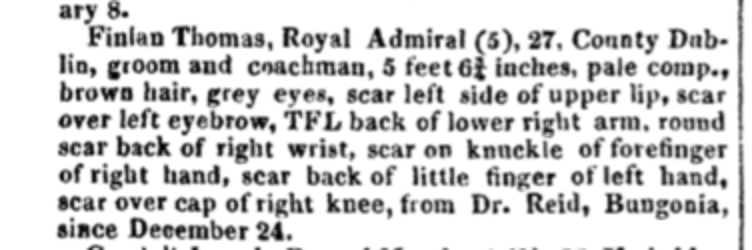
Absconded Record Number 2: 1840 – Government Gazette Notices – New South Wales Government Gazette (Sydney, NSW : 1832 – 1900)Wednesday 5 February 1840 – Page 125
The ‘Convict Indent on Arrival’ in Australia and two abscondment notices give a good description of Thomas. He is recorded as aged 22, can read and write, a protestant, single, from County Dublin, and a groom and coachman. He was 5”7’ in height with a pale complexion, brown hair and grey eyes. He had several scars including on the left side of his upper lip, over his left eyebrow, TFL back of lower right arm, the back of his right wrist, knuckle of his forefinger of right hand, the back of his little finger on his left hand, and over the cap of his right knee. The authorities were very thorough in the examination of the body in this regard.
Thomas was originally assigned to David Reid, a naval surgeon from Aberdeen in Scotland. Dr Reid served at Trafalgar on the Bellerophon and was a surgeon superintendent on convict ships in 1815, 1819 and 1822. He received a grant for one thousand acres March of 1822 another one thousand in January of 1823 in the Bungonia district. He named his holdings Inverary Park and was cultivating fifty six acres by 1826. He was regarded as a good agriculturalist. In 1829 his reports on bush rangers resulted in two military detachments being stationed in the region. Reid died in July 1840 so I am unsure if Thomas stayed working on the property for Reid’s wife or was moved to another place before he received his Certificate of Freedom on 10 August 1842.
He received a convict indulgence on 13 May 1843 (I am not sure the circumstances of this although I believe this was related to his marriage to Bridget). He married Bridget Conlon alias Tunney, a convict from Sligo on 2 July 1843 at West Maitland. There are two records. One is Church of England in Parramatta, St Johns and the West Maitland one is Roman Catholic. Bridget was Roman Catholic but likely still in Parramatta at the time. The marriage record states that Thomas was also Roman Catholic and he was buried in a Roman Catholic cemetery. It is quite possible that he changed his faith for marriage. He would not be the only one of my ancestors to do that.
Bridget is more of a mystery than Thomas. She stole turf. There is no other evidence of her crime or life other than records on arrival in Australia. They may be missing or sitting in a basement somewhere in Ireland. They would not be the only ones. Irish convict transportation records before 1836 were destroyed in 1922 unfortunately so unless they were a subject of a petition it is necessary to rely on records in Australia relating to convicts. Bridget was transported on Surrey II, departing Cork, Ireland on 15 November 1832 and arriving in New South Wales on 9 March 1833. She was recorded as being 28 years old, a laundress from Sligo and sentenced to seven years for her crime for which she was brought before the court on 7 April 1832. Bridget was Catholic and married with a twelve month old male child, James Tunny, on board. The women were landed on Monday 25 March and James would have been separated from Bridget. He has been untraceable to date and I suspect he did not survive the children’s home that children of convicts were sent to. The Monitor reported the convicts to be ‘a stout set of women who were generally clean’. The arrival muster records Bridget as Bridget Tunny alias Conlon from County Sligo. She was a laundress sentenced to seven years for stealing turf. She was 5’ 1” with a ruddy complexion, dark brown hair mixed with grey and hazel eyes.
The Indent has some interesting information, giving hints as to the probable family of her husband rather than her father and brothers. It mentions a possible previous conviction. She has been given a term of seven years and possibly served one. Her nose is a little crooked. The indent records previous transportations of a father, Lawrence Tunny (55 years) brother Patrick Tunny (20 years) both in the Pilot in 1817 and brother Owen Tunny (28 years) transported in the Chapman in 1817. It claims these men are from Roscommon County except Owen who was from Sligo County and all were sentenced to 7 years in 1816. All are recorded as labourers and all tried in Roscommon County. There is an Owen Tierney recorded as above from Sligo County. Is he Owen Tunney or is Owen Tunney or neither of them connected? The Tunny’s are potentially related through her husband who is not mentioned anywhere. With the age differences I suspect it is more likely.
According to records Bridget was first disposed of to William Todhunter of Sydney. She was also bonded to James Crispe of George Street in Sydney. He was a publican who had a licence for “The Angel”. She is recorded as absconding in the Government Gazette dated 25 April 1834. In the same year she is recorded against a refusal to marry Henry King aged fifty years. The refusal was given due to no ship being recorded in the application in relation to Henry.
In 1835 she applied to marry a man named John Darken. Bridget is recorded as residing at Sutton Forest and on the application married with one child. Approval is not recorded against their names and one record has ‘not allowed’ recorded on 19 September 1835 although the reason why is hard to read. Many were given permission to marry if spouses remained behind.

New South Wales, Australia, Registers of Convicts’ Applications to Marry, 1826-1851 – Ancestry.co.uk
There are two further records that may be Bridget. They are both church records at Parramatta and related to the female factory there. The first is as a witness to the birth of John Kale whose mother, Ann, was resident in the factory. John was born 10 October and baptised in the St Patrick Catholic Church on 27 October 1839. The second is as the mother of Maria Tunny, resident in the factory, born 23 October 1840 and baptised on 5 December 1840 at the same church. The witness was Margaret Redden. More research needs to be done in this area, a visit to the archives for sure.
Bridget’s death certificate records that she died 28 February 1882 in Tamworth. She is recorded as aged 52 and from Sligo in Ireland. She was in the colony for 38 years. Her father is recorded as John Conlan, a wheelwright and her mother as Catherine Summers. She married West Maitland aged fifteen years (this is not accurate) to Thomas Finlan and three children are recorded with the informant her husband. She died of ‘inflammation of the bowels, 2 days’.
Convict Ship Surrey II
The Surrey II embarked with 141 women and eleven of their children and took 124 days to reach Sydney. The ship left from the Convict Depot in County Cork with women from all over Ireland. The dates show that Bridget must have been pregnant when convicted and given birth in the county gaol. A Parliamentary Paper from the Report of the Inspectors General on the Gaols of Ireland records that “the female prisoners are employed in washing, cleaning and white washing the prison, knitting socks, stockings and blankets, quilts, making clothes for the male and female prisoners for their use on the voyage to New South Wales, making mattrasses, picking hair, and pumping water, cooking and tending the sick.” The female convicts for the Surrey were inspected at the depot in Cork. Those suffering a ‘considerable degree of debility’ where considered to have been affected by ‘the consequence of dissolute habits and very low diet at the depot’. The surgeon thought ‘better food and sea air would be useful to them.’ The outbreak of cholera in Ireland in 1832 resulted in a rather unusual experiment at the Cork gaol and then depot. It was believed by some that the distraction of music and dancing could diminish the spread of the disease.
“Since the introduction of cholera into the county gaol of Cork, a novel method has been adopted to prevent its spreading. A musician is engaged to play for the female prisoners (to whom the epidemic is entirely confined) for a few hours every evening; they are all brought together into one of the largest apartments in the prison, and such an interest is excited amongst them by the music and the dance, that they appear to forget altogether the cholera and its terrors. This mode of prevention was suggested by the idea, that as fear is a predisposing cause, nothing could tend more to diminish its influence. The same method has been tried at the convict depot, and with success” (Age, London 24 June 1832).
The Surgeon on board, Edward Ford Bromley, kept a Medical Journal from 25 August 1832 to 28 March 1833. He describes a rather unpleasant journey. He believed that the Irish female convicts were ‘very inferior to English women of the same class’. He had difficulty stopping them from smoking below decks and to keep themselves clean. He described the prisoners as having ‘a rooted dislike to every kind of cleanliness’. He described the convicts as mostly ‘taken off the town as common prostitutes, the rest the lowest descriptions of burglars and petty thieves, hardened and old offenders’.
Chief medical complaints were constipation of the bowels to a great extent, general debility, catarrah and hysteria. The provision of half a pint of wine issued to each, twice a week, was always followed by ‘drunkenness and rioting’ and Bromley recommended this practice should be stopped as it produced only ‘much mischief’. He also recommended that iron collars should be supplied since one girl took off her wooden one and threw it overboard; and that handcuffs and gags should also have been furnished. He complained that the ‘security box or black hole’ was not secure and that one woman burst out of it. To prevent this he put a chain round the box with a strong padlock. He suggested the provision of a straight-jacket. On 16 February 1833, the sugar ran out and on 24 February the wine ran out, and ‘this was the signal for a tremendous riot, fighting and quarrelling of every description’. One woman tried to stab a seaman and three had to be severely punished. The surgeon repeated his plea that the issuing of wine should be abolished since it has been ‘nearly the cause of all the riots in the ship’. Catarrh prevailed a good deal in February because of the cold winds.


What a fascinating read! Goodness, life was tough back then. What an interesting paper trail they left. Well done for finding it. Regards.
LikeLike
Thanks Sarah!
LikeLike
This is wonderful emotional stuff cousin Denise , My mother was Patricia Adeline Marsden born in Gunnedah to Samuel Marsden and Gladys Ida Brown . My uncle John Marsden has over 40 descendants of our Marsden/Brown , Mums line has 11,
LikeLike
Hello John, thank you. I meant to keep writing and need to get back to it. Life has got in the way a bit. That is interesting to know re your numbers of descendants. I am descended from Thomas Joseph Marsden who married Venetia Anne Smith. They left for New Zealand mining at Denniston on the West Coast in the early 1900’s. I know they kept in touch with family in Australia. I can send you the information I have on the family if you would like it.
LikeLike
Wow your my direct cousin Denise . I have photo’s of the Marsden boys my ggrandpop James , Francis and Thomas and BDM certificates and Convict Tickets of leave but lost our family tree online to a site my sister loaded it onto not Knowing I was in a Royal commission against the catholic church who set out to destroy our family tree and legacy. “Frank Marsden Kings of the Turf” Tulloch lodge horse racing legacy ours with both my uncles Carl and Reg Marsden 1920-30s jockeys for Frank. Reg took the Marsden horses to NZ and won races and had family over there . Any info on NZ would be great my Nephew was born there too. My uncle John Marsden’s kids and many grandkids are Stardust Circus since 1950s married into Lennon Bros Circus and Moscow Circus , Horse , Elephant, Lion and monkey trainers….
LikeLike
Hi Denise, any info you have would be greatly appreciated . My Brown family were sponsored by John Macarthur to help his wife Elizabeth run Camden Park Estate. John Hall Brown married Henrietta Chapman, Overseer of Camden Park Lazarus Chapmans daughter ,he was married to Camden grape grower John Wenz daughter all my Grandmother Gladys Ila Brown/ Marsden line . John Wenz built the Lochinvar tavern and planted his grape vines up the Hunter Valley . Browns founded Wagga Wagga area with the Chapmans 1800s… Some Browns had racehorses with “Frank Marsden , Kings of the Turf” Gaulusville stables.
LikeLike
Hi John, sorry for the late reply. I am living in Ireland at the minute so time differences an issue. Are you happy for me to email you on your email address? I can send what I have. It is still all a work in progress. Any info you have would be great as well.
LikeLike
Yes That Would be great Denise, A private email would be better then the website that all can read . I have a lot of knowledge on our genealogy with more surprises to come so stayed up late to catch you in the Irish morning . Kamilaroi tribe at Gunnedah I was initiated into aged 7 in 1969 but moved to Newcastle 1970 . Our Circus cousins also initiated from their West/Wright family line of Kamilaroi in Tamworth
LikeLike