# 52/6: An historical version of Social Media

Historical newspapers can be a goldmine for developing a sense of neighbourhood, place and language. For my Anderson ancestors in Sligo on the west coast of Ireland this certainly proved to be so. Reports verified occupations, family relationships, locations and neighbours. This helped where other evidence were missing. William Anderson’s wife Margaret and children, found one way or another, are highlighted above. They were one form of 21st century social media in the 19th century.
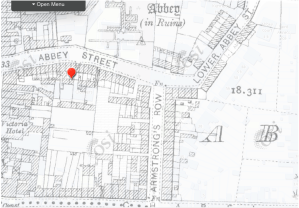
Armstrong’s Row c1870, Sligo. The Garavogue River is on the other side of the Abbey at the top of the image. Armstrong’s Row is now the location of the Abbey carpark and the street is now partly Charlotte Street and partly St Joachim’s Terrace.

The first mention of William and Margaret  Anderson’s family in Sligo’s newspapers occurred on 12 January 1849 where William, master chimney sweep, and town officer John Jennings were praised for apprehending John Tiernan “in the process of stealing a carpet bag belonging to Mark Brennan from a car on the way to Collooney”[1]

From then most of the family were regularly recorded as they navigated relationships with, in particular, their neighbours. These episodes in their life provide an image of a rambunctious family as is shown in the following extracts as well as showing a little about types of cases and workings of the Petty Sessions. 

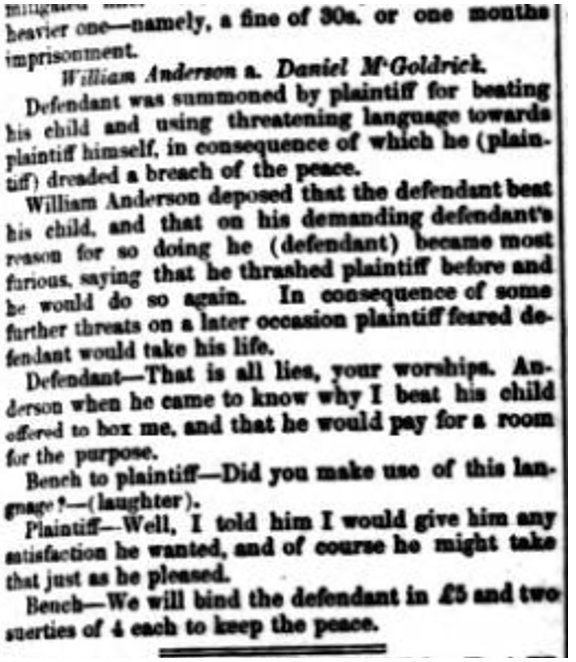
In 1856 William summoned Daniel McGoldrick “for beating his child and using threatening language towards himself, in consequence of which he “dreaded a breach of the peace.” McGoldrick claimed “he [had] thrashed [William] before and…would do so again”. Following threats William declared he feared for his life. McGoldrick denied this, stating “that is all lies, your worships. Anderson, when he came to know why I beat his child offered to box me, and that he would pay for a room for the purpose.” The bench asked William if he made “use of this language” to laughter from the court. William replied that “Well, I told him I would give him any satisfaction he wanted, and of course he might take that just as he pleased”. McGoldrick was bound over for five pounds and two sureties of ½ each to keep the peace[2]

McGoldrick/Anderson incident 1856
Continue reading “# 52/6: An historical version of Social Media”

#52/2: A photo – Cholera in Dublin 1832

It takes ten minutes to walk from my home to the Broadstone Luas stop near Grangegorman in North Dublin. Broadstone is opposite Kings Inn Park, Irelands oldest school of law and the home of the ‘Hungry Tree’ on Constitution Hill, a short walk to a previous tenement turned tourist attraction at 14 Henrietta Street, and 750 metres to St Michans Park, the site of the former Newgate Prison in Dublin on the corner of Halston and Little Britain Streets. It is an area full of historical importance that is not so immediately obvious today. But what do these areas have in common, why this photo, and how are they connected to Thomas? 

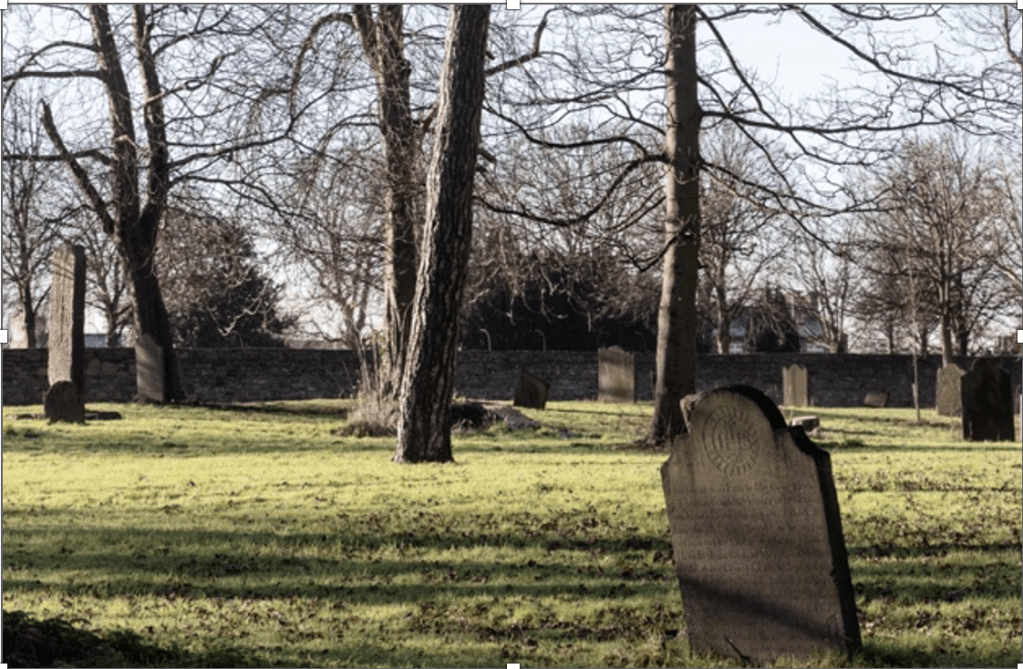
Image of Bully’s Acre Kilmainham, Dublin, Ireland Personal Photo Denise Brown

The photo is of a place. Thomas Finlan left no photo of himself, it was too early for that. The place, Bully’s Acre, was a burial ground he perhaps knew rather well. It is connected to events and conditions, unimaginable for many of us, that he lived through and which I imagine influenced his decisions. Additionally, his stomping ground then is partly mine today which is somewhat strange to me. I am not from Ireland and never imagined that one day I would live here.

One of the newspaper reports of Thomas’ arrest for highway robbery in 1833 stated that 

In about 2 hours, after Dunn was taken into custody, Peace officers McDonagh and Scott arrested a well-known resurrectionist, Thomas Finlan, as he was coming out of a public house on Mercer Street…Finlan was immediately identified as the person who had attacked Mr Dunroche…it is only due to the police these arrests have been made…one of the most daring gangs that ever infested the neighbourhood of this city has been at length arrested…

Continue reading “#52/2: A photo – Cholera in Dublin 1832”

A Sligo Master Sweep

A change in tradition in relation to cleaning occurred in the early eighteenth century as “…householder[s] in England…transform[ed] small children into human brooms for sweeping out their flues”[1]

In April 1880 the Sligo Workhouse master informed his governors that the chimneys needed sweeping. However, the contractor had died recently and he did not feel it prudent to bring in the son in his stead. How was he to progress? The governors ordered the purchase of a chimney-sweeping machine to be operated by resident paupers.[2] The contract had only just been renewed at £10 (around £1263 in 2021) per annum. The master sweep, my three times great grandfather, William Anderson, had held it for at least the past thirty years. He died on 12 March at the age of 62 years of typhus fever, the day before the renewal of the contract was confirmed on 13 March 1880[3]

The first mention of William is his marriage to Margaret Hill, witnessed by Mark Smyth and Cecelia McHugh, in the Roman Catholic Chapel on 4 January 1841 in Sligo. How he became a master sweep, his attitude toward the use of children as apprentices and the use of new technology can only be speculated. Some master sweeps were apprenticed as climbing boys, some were never apprenticed to the trade. Some purchased an existing business, inherited their father’s, married a sweep’s widow, or simply needed an income. What is known is that William had apprentices, employed journeymen and owned at least two sweeping machines during his career. His youngest son, named William, also entered the profession for a time at least. 

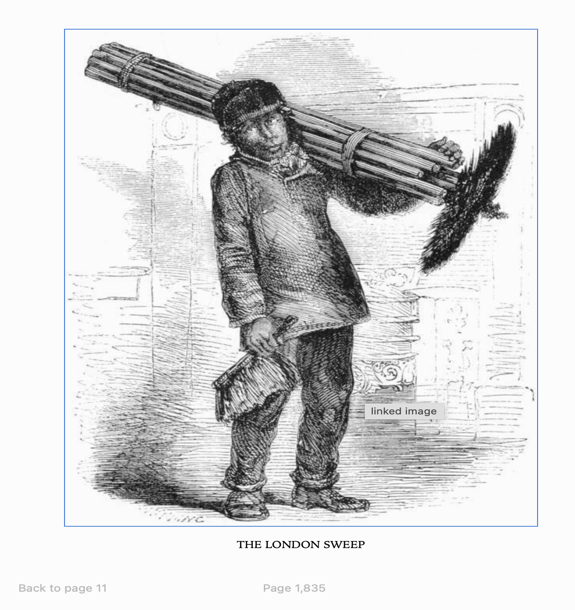
London Sweep[4]
Continue reading “A Sligo Master Sweep”