
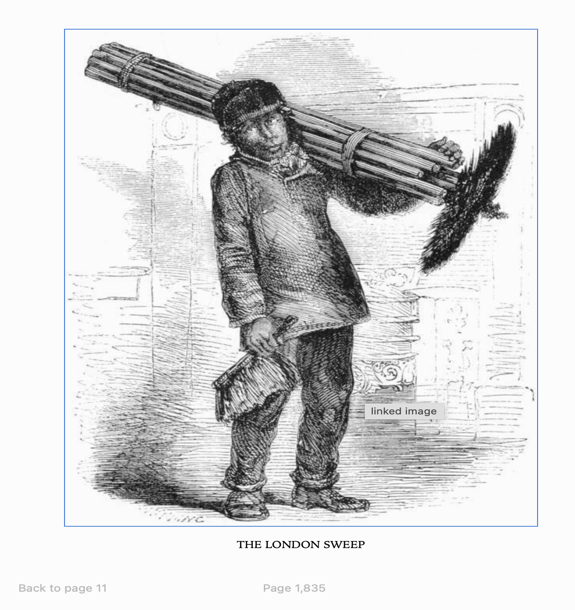
A change in tradition in relation to cleaning occurred in the early eighteenth century as “…householder[s] in England…transform[ed] small children into human brooms for sweeping out their flues”[1]
In April 1880 the Sligo Workhouse master informed his governors that the chimneys needed sweeping. However, the contractor had died recently and he did not feel it prudent to bring in the son in his stead. How was he to progress? The governors ordered the purchase of a chimney-sweeping machine to be operated by resident paupers.[2] The contract had only just been renewed at £10 (around £1263 in 2021) per annum. The master sweep, my three times great grandfather, William Anderson, had held it for at least the past thirty years. He died on 12 March at the age of 62 years of typhus fever, the day before the renewal of the contract was confirmed on 13 March 1880[3].
The first mention of William is his marriage to Margaret Hill, witnessed by Mark Smyth and Cecelia McHugh, in the Roman Catholic Chapel on 4 January 1841 in Sligo. How he became a master sweep, his attitude toward the use of children as apprentices and the use of new technology can only be speculated. Some master sweeps were apprenticed as climbing boys, some were never apprenticed to the trade. Some purchased an existing business, inherited their father’s, married a sweep’s widow, or simply needed an income. What is known is that William had apprentices, employed journeymen and owned at least two sweeping machines during his career. His youngest son, named William, also entered the profession for a time at least.
 Tales2Tell