It takes ten minutes to walk from my home to the Broadstone Luas stop near Grangegorman in North Dublin. Broadstone is opposite Kings Inn Park, Irelands oldest school of law and the home of the ‘Hungry Tree’ on Constitution Hill, a short walk to a previous tenement turned tourist attraction at 14 Henrietta Street, and 750 metres to St Michans Park, the site of the former Newgate Prison in Dublin on the corner of Halston and Little Britain Streets. It is an area full of historical importance that is not so immediately obvious today. But what do these areas have in common, why this photo, and how are they connected to Thomas?
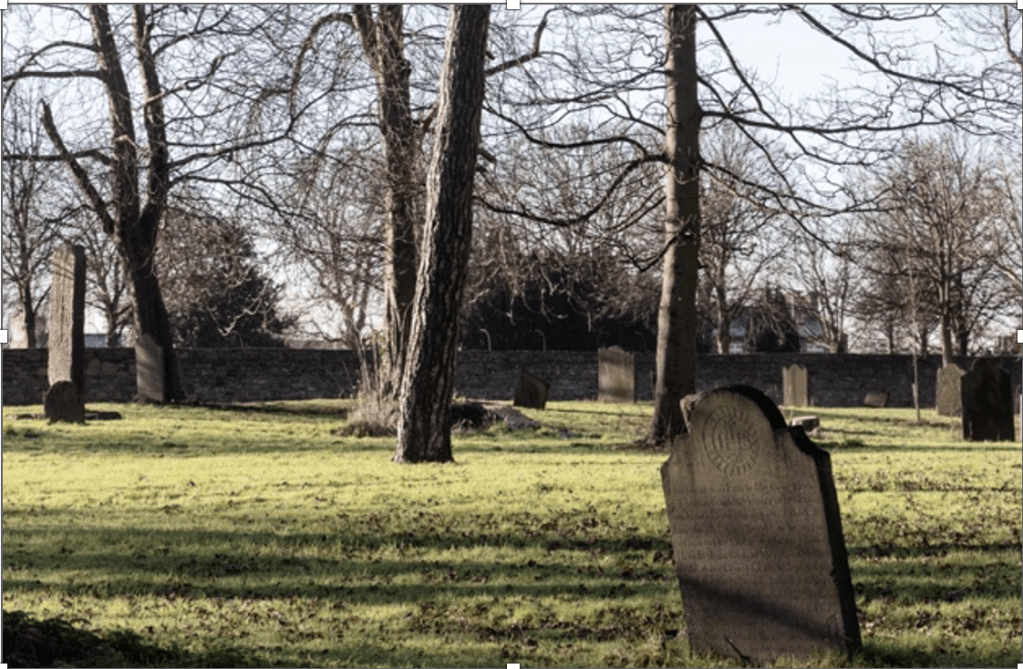
Image of Bully’s Acre Kilmainham, Dublin, Ireland Personal Photo Denise Brown
The photo is of a place. Thomas Finlan left no photo of himself, it was too early for that. The place, Bully’s Acre, was a burial ground he perhaps knew rather well. It is connected to events and conditions, unimaginable for many of us, that he lived through and which I imagine influenced his decisions. Additionally, his stomping ground then is partly mine today which is somewhat strange to me. I am not from Ireland and never imagined that one day I would live here.
One of the newspaper reports of Thomas’ arrest for highway robbery in 1833 stated that
“In about 2 hours, after Dunn was taken into custody, Peace officers McDonagh and Scott arrested a well-known resurrectionist, Thomas Finlan, as he was coming out of a public house on Mercer Street…Finlan was immediately identified as the person who had attacked Mr Dunroche…it is only due to the police these arrests have been made…one of the most daring gangs that ever infested the neighbourhood of this city has been at length arrested…
This is a hard question to answer because in truth I would like to meet them all. I have too many questions and there is a lot of smoke and misdirection surrounding the lives of most, particularly those who ended up in New South Wales in Australia in the early nineteenth century, either compelled to ’emigrate’ or by personal choice.
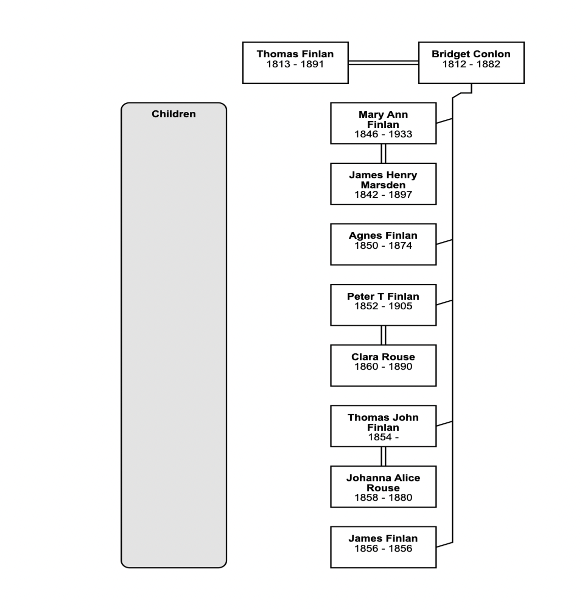
I would like to focus on one couple, Thomas Finlan and Bridget Conlon alias Tunney, in particular for the next eight weeks worth of prompts so this will not really be 52 ancestors but hopefully close to 52 weeks of posts. Thomas and Bridget were both from Ireland, one from the east coast and one from the west coast, both convicts, and both transported in the early to mid 1830s. Their crimes were polar opposites, but both seem to have had a rebellious and independent streak, were resilient and I like to think, were at least somewhat happy with the way their lives turned out.
Thomas Finlan was born in County Carlow in Ireland c1809. There is no definitive evidence of date, townland, names of parents or other identifying facts to help get beyond that rather sparse information found to date. The name Finlan was more common in the South East of Ireland in the nineteenth century, particularly in County’s Carlow and Kilkenny so it is likely that Carlow is correct. Further, it was given on son James’ birth certificate in 1856 and Thomas was the informant in this instance. Convict records record Thomas as from County Dublin, where he was caught and convicted.
The texture of life on board an emigrant ship in the nineteenth century required a modicum of patience to cope with a dire lack of personal space, and was run on a regimented system within a framework of rules set according to the values of Victorian Britain. Emigrants came with distinct languages, customs, beliefs, prejudices and institutions. As on land, they were divided along social lines in every aspect of shipboard life. Emigrants were strictly separated according to class, marital status and gender. There were rules and expectations of behaviour on matters of morality that continued to cause consternation to authorities throughout the nineteenth century and well into the twentieth. Improper liberties, especially among single men and women, blasphemy, language, gambling, and violence were strictly monitored. To further complicate matters, divisions along lines of religion and ethnicity played out as discomfort and tensions increased.
Emigration was a defining event for Sutherland, McIver and Webster individuals and families, so what set of circumstances encouraged them to emigrate on a lengthy, uncomfortable and risky voyage? For John and Mary Sutherland, County Sutherland, their home in the far north of Scotland was infamous for both the organisation and scale of the clearance of tenants from the interior of the estate to its coastal regions for sheep. Between six and ten thousand people were removed from their homes between 1807-1821 alone. It has been described as an ‘extraordinary episode.’[1]The next three decades saw the collapse of the kelp industry, potato crop failures in the 1830s and 1840s, a severe winter in 1837 and typhoid and scarlet fever.
“I am prepared to go anywhere, provided it be forward” (David Livingston)
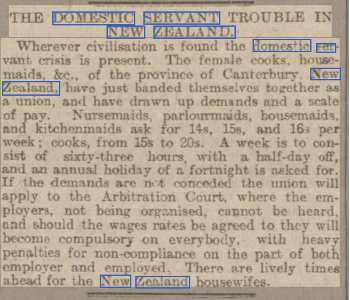
Edinburgh Evening News 25 November 1903
A Census of the British Empire in 1906 recorded Great Britain as ruling one fifth of the world. Domestic workers in New Zealand were calling for a 63-hour working week with a half day off and a fortnight off every year. Mount Vesuvius erupted devastating Naples and the San Francisco earthquake and fire killed close to 4000 residents.
On 29 November 1905, my great grandmother Annie Webster left London for New Zealand on the steamship Turakina, a journey of some 24,000 km. The ship was fairly new, built in Dumbarton by William Denny and Brothers for the New Zealand Shipping Company. It had refrigerated cargo space to cater for the import/export market between Britain and its colonies. It could accommodate around 360 passengers, including accommodation for first- and second-class customers. The Turakina had completed its maiden voyage in late 1902 but had a short life – it was torpedoed and sunk less than fifteen years later on 13 August 1917 whilst carrying troops to New Zealand via New York with the loss of four lives.
Annie was one of 168 third class passengers, and contracted to disembark in Wellington, New Zealand. She was on the same ticket as Miss M Wilson, both of whom are recorded as Scottish and domestics. It is not known all the reasons she chose to leave Scotland but a new start seems to be a likely reason. After 70 days at sea, Annie arrived in Wellington at 3.40 am on 16 January 1906 as one of 219 passengers and 5653 tons of cargo (Otago Daily Times, 17 Jan 1906) including livestock imported for individuals; pedigree sheep, fowls, bantams, pigeons and canaries (Marlborough Express 1906, Wanganui Herald, 1906).
The Turakina
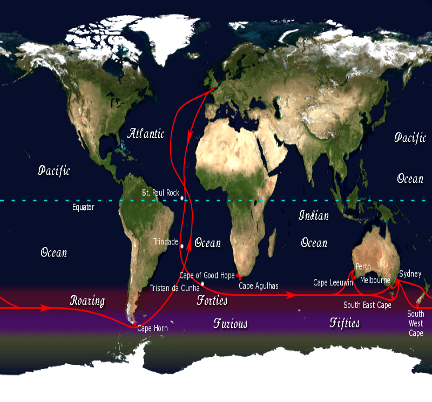
Although the Suez and Panama Canals had opened in 1869 and 1914 respectively, the New Zealand Shipping Company that Annie sailed with continued using the traditional route to Australia and New Zealand until at least later in 1914, with coal stops in Tenerife, Cape Town and Hobart.
The Turakina reported ‘moderate seas and winds to latitude 22 degrees south’, and ‘strong head winds and high seas’ to Cape Town which the ship reached on 22 December. She sailed again on the afternoon of 23 December, experiencing ‘moderate winds and seas’ in the Southern Ocean, before arriving in Hobart, Australia on 11 January. Twenty-three passengers disembarked in Hobart, along with the unloading of 361 tons of cargo and the ship left that same afternoon for Wellington (Lyttelton Times, 1906).
Route England to New Zealand
There was little time for sightseeing at designated stops. The Turakina arrived and departed from a fuel stop in Tenerife on 7 December. Such a stop was described by John Lynn in the diary he wrote in 1911 on his journey to Australia (Notes on Voyage, 1911: High jinks on the high seas. Edited by David Ransom 2021 and available on Amazon.com). Lynn noted that as they were due to arrive at Las Palmas, orders were given that money and valuables be put in the safe of the Chief Steward as locals would be coming on deck to sell their wares/fruit. He described the scenery of ‘gaily painted buildings of red, white, blue, and green at the foot of red sandstone hills’, fishermen, and boats full of locals coming to sell fruit, slippers, shawls, tobacco, wine, spirits, and chocolate. 300 tons of coal were loaded onto the ship in bags. On enquiring what wage per day [the coal loaders] received for ‘that dirty, hard work’ he was appalled to hear it was 1/- per day. In response he said he ‘is not surprised they do not want missionaries if the Englishman pays so little’, as it is a poor example of ‘Christian England’. It is likely that Annie experienced similar sights and sounds.
Shipping record showing Annie embarking in London and contracted to Wellington
It is worth noting further experiences Lynn reported on as they are repeated in many a migrant’s diary of their journey over several decades. Recurring themes were the misery of seasickness on entering the Bay of Biscay. Rough seas resulting in general chaos were mentioned several times with personal items being thrown about in rooms; slipping from one end of the bed to another while trying to sleep; and dining in rough weather with meals ending up on the floor. On Lynn’s particular trip, he, at one point, reported ‘high seas with crests of up to 60 yards rounding the Cape…the vessel was below the level of the sea with waves breaking over them…noise like thunder, and rolling up and down and side to side’.
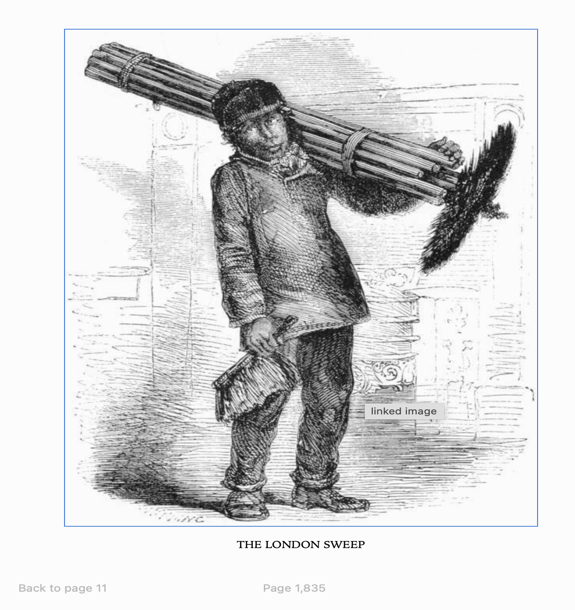
A change in tradition in relation to cleaning occurred in the early eighteenth century as “…householder[s] in England…transform[ed] small children into human brooms for sweeping out their flues”[1]
In April 1880 the Sligo Workhouse master informed his governors that the chimneys needed sweeping. However, the contractor had died recently and he did not feel it prudent to bring in the son in his stead. How was he to progress? The governors ordered the purchase of a chimney-sweeping machine to be operated by resident paupers.[2] The contract had only just been renewed at £10 (around £1263 in 2021) per annum. The master sweep, my three times great grandfather, William Anderson, had held it for at least the past thirty years. He died on 12 March at the age of 62 years of typhus fever, the day before the renewal of the contract was confirmed on 13 March 1880[3].
The first mention of William is his marriage to Margaret Hill, witnessed by Mark Smyth and Cecelia McHugh, in the Roman Catholic Chapel on 4 January 1841 in Sligo. How he became a master sweep, his attitude toward the use of children as apprentices and the use of new technology can only be speculated. Some master sweeps were apprenticed as climbing boys, some were never apprenticed to the trade. Some purchased an existing business, inherited their father’s, married a sweep’s widow, or simply needed an income. What is known is that William had apprentices, employed journeymen and owned at least two sweeping machines during his career. His youngest son, named William, also entered the profession for a time at least.



 Tales2Tell